





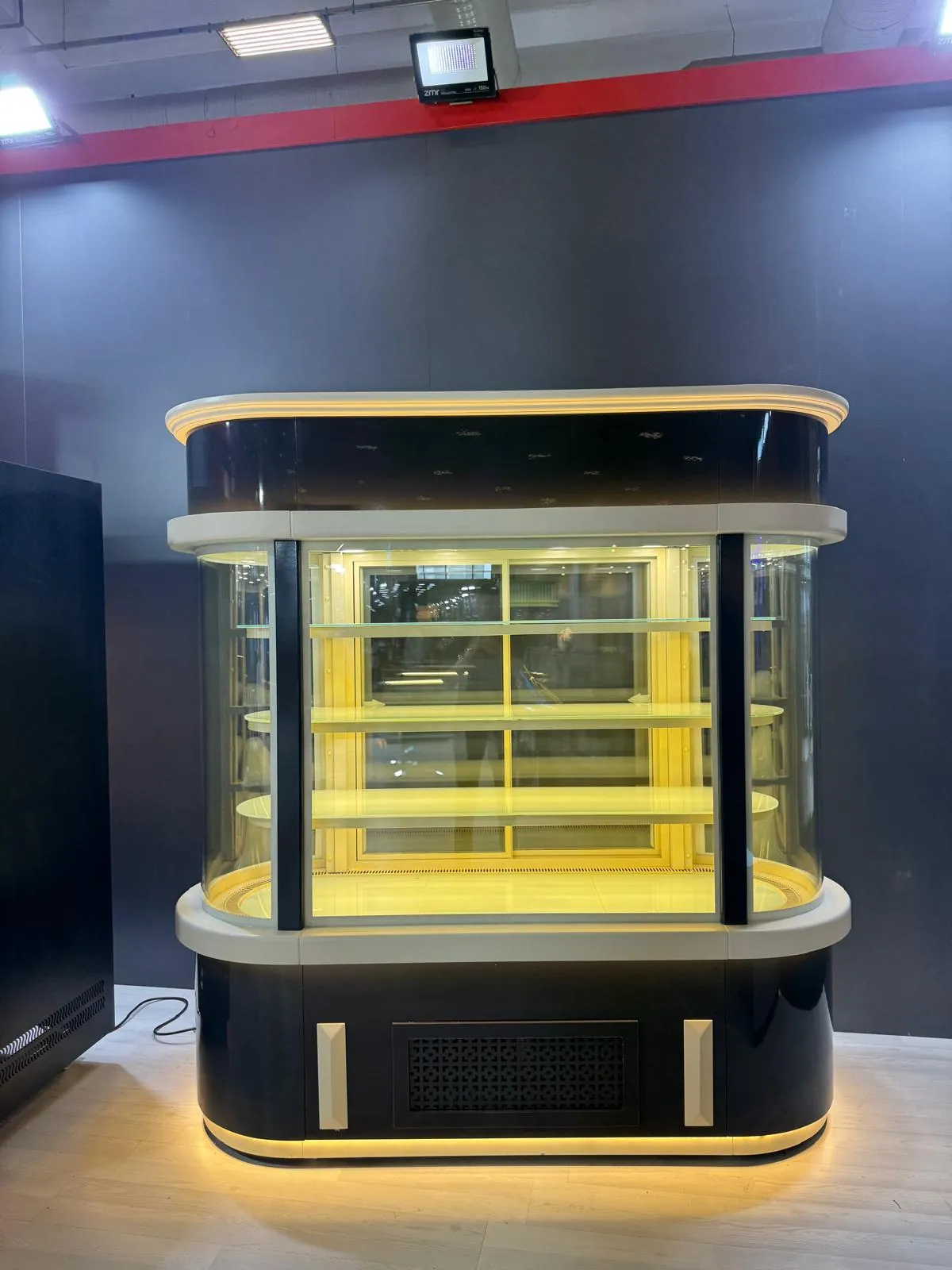
Static or Fan-Assisted? Choosing the Cooling System for Your Display Cabinet

When buying a display cabinet, most business owners focus first on dimensions, glass type and appearance. Yet the most important choice in determining how your products will be preserved inside the cabinet is the type of cooling system. Of two cabinets set to the same temperature, one can keep your cakes fresh for days while the other can dry them out within a few hours. This is exactly where the difference between static vs fan-assisted cooling comes into play. In this article, drawing on our field experience as a workshop that builds made-to-measure display cabinets, we explain how the two systems work, how they differ in terms of humidity, temperature balance, fogging, energy and noise, and which one is preferred, and why, for product groups such as cakes, deli products and drinks.

How does static cooling work?
In static cooling, the evaporator, which acts as the cold surface, is usually placed at the top of the cabinet, on the rear wall or under the display base, and there is no fan to move the air. Air that has cooled becomes heavier and sinks, while air that has absorbed heat from the products rises. In other words, the air inside the cabinet moves in a slow cycle known as natural convection.
The most important result of this slow, gentle air movement is that only a limited amount of moisture is drawn from the product surface. Because air does not flow quickly over the products, uncovered cream, jelly-glazed or sliced products keep their glossy, moist appearance for longer. On the other hand, the temperature difference between different points in the cabinet can be more pronounced, and the internal temperature takes longer to return to the set point after the door has been opened.
How does fan-assisted cooling work?
In a fan-assisted (also called ventilated or forced-air) system, a fan placed in front of or behind the evaporator blows cold air into the cabinet through dedicated ducts and vents. The air follows a planned path around the cabinet and returns to the evaporator. On open-front counters, this airflow also forms a cold air curtain across the front opening.
Thanks to the constantly moving air, the temperature is much more even across every point of the cabinet, the internal temperature recovers quickly after the door has been opened and closed, and even a fully loaded cabinet is cooled evenly. The trade-off is that more moisture is drawn from the product surface: unwrapped and delicate products can dry out more quickly where the airflow hits them directly.
Humidity and drying: what determines product quality
The most critical difference between the two systems is the relative humidity inside the cabinet and how quickly products dry out. By its nature, cold air deposits its moisture on the evaporator surface; the faster the air circulates, the more moisture it takes from the product and carries to the evaporator.
- Unwrapped products with exposed surfaces (cream cakes, tarts, cut cheeses, sliced deli products, salads) are sensitive to moisture loss. In these products, drying shows up as cracking, dulling, hardened edges and darker colours.
- Packaged products or products in closed containers (bottled and canned drinks, vacuum-packed products, packaged dairy products) are not affected by airflow; what matters for them is fast, even cooling.
For this reason, static cooling has long been preferred in patisserie and deli counters that display delicate, uncovered products. For packaged products, the advantages of fan-assisted systems come to the fore. That said, fan-assisted designs with low air speed that direct the air around the product rather than over it are also in use today; with the right duct design, the drying effect in a fan-assisted cabinet can be reduced considerably.
Temperature uniformity and fogging
Temperature balance
In static cabinets, cold air tends to collect at the bottom and relatively warmer air at the top. Depending on where the evaporator is, some zones can stay colder and others warmer. This difference can be managed with the right product placement: the most sensitive products go in the coldest zone. In fan-assisted cabinets, the temperature difference is much smaller and the whole cabinet can be used more flexibly. In a cabinet whose door is opened frequently at busy times, the fast-recovery advantage of a fan-assisted system is clearly noticeable.
Fogging
Fogging occurs when humid room air meets the cold glass surface. In fan-assisted systems, air moving close to the glass surface makes it harder for fog to form and persist. In static cabinets, the glass can be more prone to fogging, especially in warm, humid environments; that is why thermally insulated glass, glass heating solutions and correct placement become even more important with static systems. Room conditions are decisive with both systems: air-conditioning drafts, wind from the door and high humidity all increase fogging.
Energy consumption and noise
It would not be right to give a one-line verdict on energy; consumption depends heavily on the cabinet’s size, insulation, glass type, whether it has doors or an open front, and how it is used. Even so, the general trends can be summarised as follows:
- In a static system there is no fan motor, so there is no consumption on that item. However, because heat transfer inside the cabinet is slower, the compressor may run longer to reach the set point in places where the door is opened often and products turn over quickly.
- In a fan-assisted system the fan motor runs continuously or under control and consumes some electricity, and it also adds a small amount of heat to the cabinet. In return, heat transfer is more efficient, so the cabinet reaches the set point faster and holds the temperature more easily.
- Defrost: In fan-assisted systems, more moisture is carried to the evaporator, so the need for defrosting and its management are more significant. In static systems, ice builds up more slowly but should not be ignored.
In terms of noise, static cabinets are quieter; the only sound you hear comes from the compressor. Fan-assisted cabinets have a constant low hum from the fan. In a café, boutique patisserie or quiet sales area this difference can be noticeable, whereas in a busy supermarket it is usually not a deciding factor. With good-quality, correctly sized fans, this noise can be kept at a very low level.
The right choice by product type: examples
Cake and dessert display cabinets
Cream cakes, cheesecakes, fruit tarts and jelly-glazed desserts are the products most sensitive to moisture loss. For this group, static cooling or specially designed fan-assisted systems with low air speed that do not blow air directly onto the product are preferred. The target range is generally +2/+6 °C. We cover the other criteria for choosing a cake cabinet in detail in our article on what to consider when choosing a cake display cabinet.
Deli and butcher counters
Sliced cheeses, uncovered deli products and meat dry out and change colour quickly when exposed to airflow. In serve-over counters, where staff hand the products to the customer, static cooling is a common and successful solution in both curved-glass and straight-glass versions. The target range is generally 0/+4 °C. In self-service deli counters displaying packaged products, a fan-assisted system is more suitable. For the differences by glass type, see our deli counter buying guide.
Drinks and packaged product cabinets
With bottles, cans and packaged products, drying is not an issue, so fan-assisted cooling is the clear winner. Frequently opened doors, heavy restocking and the expectation of the same chill on every shelf make the fast recovery and even temperature of a fan-assisted system valuable. That is why a fan-assisted system is the standard choice in upright display cabinets.
Baklava, chocolate and bakery products
Products such as baklava and syrup-soaked desserts, pralines and chocolate, dry pastries and börek each have different needs. Some are damaged by high humidity, others by drying out, and some need only a cool, controlled environment rather than refrigeration. For products like these, the soundest approach is to decide on the cooling type product by product and, if necessary, divide a counter into separate compartments. In patisserie and bakery counter projects, we usually plan this separation together with the customer at the layout drawing stage.
Comparison table: static vs fan-assisted cooling
| Criterion | Static cooling | Fan-assisted cooling |
|---|---|---|
| Air movement | Natural convection, slow and gentle | Fan-forced, planned circulation |
| Product drying | Low, uncovered products keep their moisture | Higher, can be reduced through design |
| Temperature uniformity | More pronounced difference between zones | Even throughout the cabinet |
| Recovery after door opening | Slower | Fast |
| Glass fogging | More prone in humid environments | Less, thanks to the airflow |
| Noise | Quieter | Low-level fan noise |
| Energy | No fan consumption, depends on usage | Fan consumption, more efficient heat transfer |
| Suitable products | Cream cakes, uncovered deli, meat, serve-over counters | Drinks, packaged products, self-service counters |
Questions to ask before you decide
The right cooling system depends on your products, the way you sell and your premises. Answer the following questions to clarify your choice:
- Are most of the products you will display packaged, or do they have exposed surfaces?
- Is it serve-over selling (staff hand over the product) or self-service?
- How often will the cabinet door or front opening be opened during the day?
- What are the temperature and humidity like on the premises; is the air conditioning sufficient in summer?
- How important is quiet operation for your sales area?
- Will you display products with different needs together in the same counter?
If the answers to these questions do not point to a single system, compartmentalised designs or a layout plan that spreads product groups across separate units may be the best solution. For needs like these that do not fit standard sizes, take a look at our custom-designed units.
Frequently Asked Questions
Can fan-assisted cooling be used in a cake cabinet?
It can, but it requires a design in which the air speed is kept low and the air is not blown directly onto the product. Otherwise, cream-topped and uncovered products can dry out quickly. For patisserie products, static systems or fan-assisted systems designed to minimise drying should be preferred.
Which one uses less energy?
There is no definitive answer. A static system has no fan consumption, while a fan-assisted system transfers heat more efficiently and so reaches the set point faster. Real consumption is determined by the cabinet’s size, insulation, glass type and usage habits.
Why does the glass on my static cabinet fog up?
In static cabinets there is little air movement over the glass surface, so fogging forms more easily in warm, humid environments. Controlling air-conditioning and door drafts, checking the seals and lowering the room humidity usually reduce the problem.
Can I change the cooling type of my existing cabinet?
This depends on the cabinet’s body and duct structure and, in most cases, requires extensive modification. If your product range has changed, planning a new unit suited to your new needs usually gives a better result than converting the existing cabinet.
If you are not sure which cooling system suits your products, browse our completed projects or share the products you will display and the dimensions of your premises to request a quote. Our team will recommend the right cooling type for your products along with a layout drawing.
Would you like a free site visit and quote for your project? Share your dimensions and requirements, and we’ll come back to you with a solution tailored to you.
Request a Quote · Message us on WhatsApp · +90 533 454 56 07


